
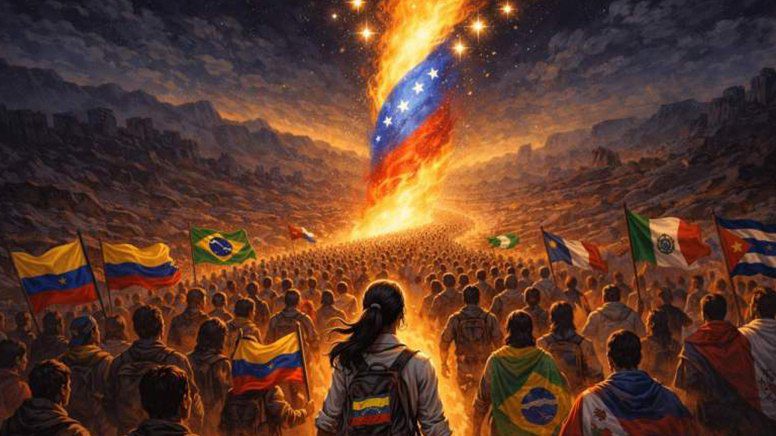
In November of last year (2025), Zanny Minton, Editor-in-Chief of The Economist, wrote: “Next year (2026) will define the new world order because 2025 demolished the old one. President Donald Trump has remade decades-old norms and institutions as dramatically as he is remodeling the White House.” And so we begin this new year… with our eyes turned toward Venezuela: a regime in decline and a future filled with questions. From my perspective, it is a country now charged with as much hope as symbolism.
The first point to reflect on is that what is happening today in the South American country is part of a broader reordering of power in a new era dominated by geopolitics—an era in which borders, regions, and spheres of influence once again become the key factors to decipher in order to understand the new world. In this context, we must analyze what lies ahead for Venezuela, but also the global implications.
Venezuela: The Two Transitions
My first expectation is that the so-called “land of grace” will undergo two transitions before entering a period of stabilization. The first would be led by the previous regime, currently headed by interim president Delcy Rodríguez, always guided by the directives of the U.S. government; the second, ideally months later, by an opposition government (also with significant U.S. influence), which would experience the shock of regime change and eventually give way to a subsequent administration with greater legitimacy. The possibility of this transition toward conditions of relative democracy would have Marco Rubio as a key actor. While democratic transition may be secondary for Trump, for the Secretary of State it could be a priority so long as it does not conflict with national security. If such a transition promises stability for the country, it could become a shared objective that successfully leads the process forward.
A period of stability would likely arrive in this third phase, marking the beginning of a long process to rebuild everything that the Chávez and Maduro eras destroyed. Before reaching that point, however, there is the risk of a reconstruction of the authoritarian model—one that, by providing relative stability, particularly in controlling social unrest and safeguarding oil operations, could encourage the United States to accept the regime. Even though rebuilding the economy, infrastructure, and democracy could take considerable time, the prevailing hope is that families separated by the brutality of dictatorship may reunite, restoring a sense of hope among people long battered by poverty, violence, and a lack of freedom.
A Test for the Stars and Stripes
The land of “chévere” will also allow us to see more clearly not only U.S. interests but how American foreign policy is being woven into this new geopolitical moment in history. There is no doubt that in the days and months ahead Venezuela could face even worse moments than those it has already endured. Internal power struggles, competing interests, and even chaos could take center stage. A new wave of scarcity in a country barely surviving could trigger another exodus before stabilization arrives. The United States may remain in the country to prevent the regime from reorganizing and to protect its oil interests, but it could also choose to become actively involved in the stabilization process. This, however, would require leading a major humanitarian aid campaign capable of enabling political and social reconstruction. We will see whether the stars shine again.
Freedoms and Interests
There are moments when interests converge with freedoms. This is no small matter and should be celebrated, yet we must not confuse the two. U.S. intervention does not appear to be a crusade for democracy, but rather a declaration: of American military strength and its willingness to intervene in world affairs in pursuit of its own security and interests.
The interests involved in this issue are numerous and complex. Venezuela’s proven oil reserves are no minor matter; they are estimated to exceed 300 billion barrels—more than four times U.S. reserves. Yet today Venezuela is outproduced by the United States by a factor of thirteen in daily barrel output, and its extra-heavy crude is not easily marketable. The immediate assumption might be that the United States will seek to exploit these reserves for its own benefit. However, we should remember that the phrase “America for Americans” has already been painted red.
Venezuela sends around 80% of its oil exports to China. While this represents only about 6% of the Asian giant’s imports, the debt that the “little Venice” has accumulated with China—particularly with the China Development Bank—is larger than that of any other Latin American country, totaling roughly $60 billion. Approximately two-thirds of oil exports to China generate liquidity, while the remaining third services debt. We should not expect China to remain uninvolved, given its significant interests. And if it does choose not to get involved, that could be even more dangerous—perhaps signaling a decision to strengthen its interests within its own sphere of influence, such as Taiwan.
Unlike the United States, for which oil is the primary energy source, China still relies heavily on coal while simultaneously strengthening renewable energy generation more than any other country in the world. If imports from Venezuela weaken, this would only deepen China’s relationship with the three countries that already account for more than 50% of its oil imports: Iran, Saudi Arabia, and Russia—implications we will address another time.
And Mexico?
For those who watched closely the press conference held by President Trump and several top officials regarding intervention in Venezuela, we heard repeated and emphatic statements that the United States does not threaten—it acts and achieves results. If we add this to the intervention itself, it becomes clear that this is only the beginning of an escalation not just in rhetoric but in action. Venezuelan cartels represent a far lower level of risk to the United States than Mexican cartels. Without a doubt, the year begins in Venezuela—but it is only just beginning.